
· by Michael Blair, Nashville's Countertops
Stone countertops fail in two ways that can look alike from above. A chip is local damage from a knock, and we can fill it in place. A crack that runs across the stone has a cause behind it, usually the support underneath or heat, and we want to know which before we fill anything.
Where do stone countertops chip?
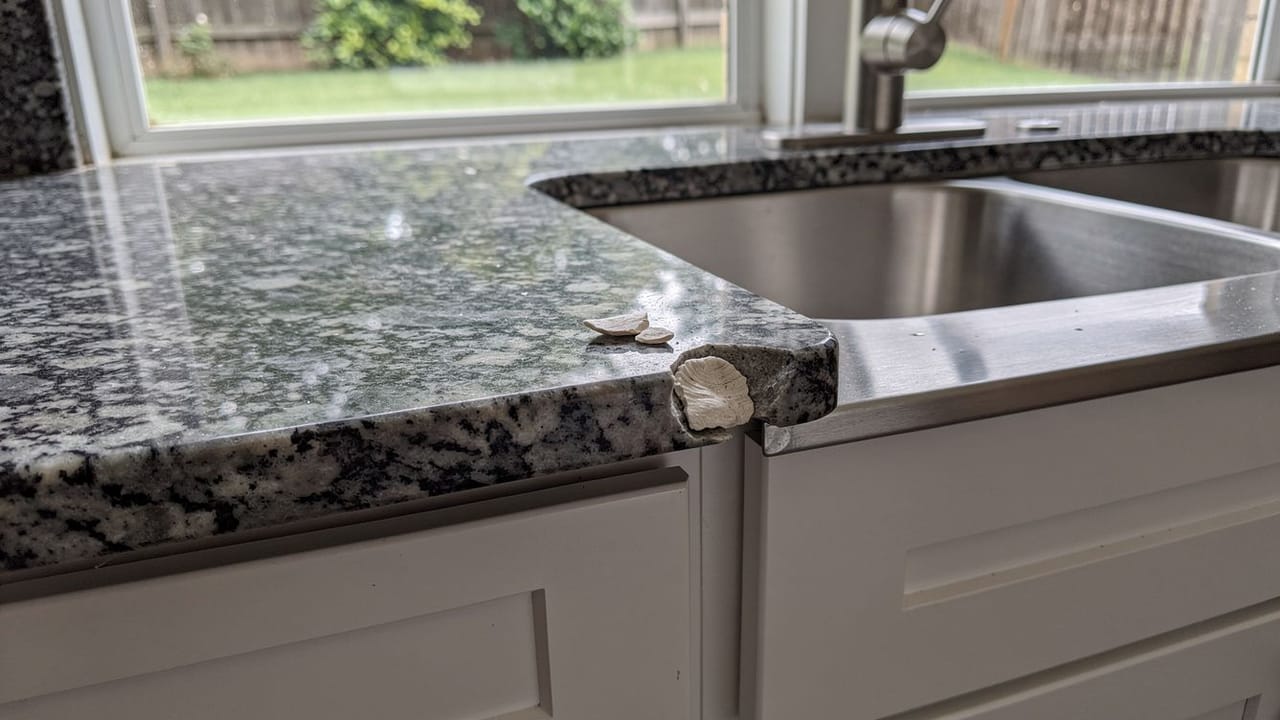
Chips show up where the stone is exposed to knocks. Cambria’s care guide says plainly that no stone is chip-proof and that objects hitting edges, particularly at sinks or dishwashers, may cause chips. A dropped pan or a bottle set down hard on the edge of a sink cutout is the usual story, and that’s where most of the chips we see are, along with the front edge and the corners of the sink and cooktop cutouts.
We fill a chip with a color-matched epoxy, let it cure and polish it flush. How well it hides depends on the stone. The same Cambria guide notes that surface marks show more on monotone designs than on multicolored ones, and we set expectations for a fill the same way: a busy granite swallows it, while a plain quartz leaves it easier to spot.
Cracks, and what causes them
When we’re called to a crack, we look first at the narrow strips of stone around the sink and the cooktop, since those are the thinnest parts of the slab. Cooktop cutouts are a known trouble spot in quartz: a Montana fabricator interviewed for the Natural Stone Institute’s article on manufactured quartz said he had seen numerous failures at cooktop cutouts, more than with natural stone, and named electric frying pans and slow cookers as the biggest culprits for cracked or scorched quartz. That fits the Institute’s comparison of slab materials, which says the polymer resins in quartz may be sensitive to sustained high temperatures, while granite generally handles heat and temperature swings well.
Movement is the other cause we check. Cambria’s installation terms call for structurally sound, straight, level and square cabinets, so before we touch the stone we look at the cabinet run, the dishwasher opening and any overhang, which our post on overhangs and when they need support goes into. We don’t fill a crack until we know why it opened.
- Chip at an edge: impact damage, filled in place
- Crack at a sink or cooktop cutout: check support and heat first
- Open or dark seam: a re-seaming job, cabinets checked first
- Scorch mark on quartz: heat damage to the surface
- Any crack that moves or grows: stop and find the cause
Will a chip repair be invisible?
A good chip fill is close to invisible on patterned granite and easier to see on plain quartz or a solid dark stone, and we’d rather say that before the work than after. We also don’t promise that a filled edge is as strong as the stone around it, which matters on an edge that will take another knock.
A crack repair is a stabilization. We work epoxy into the line and, where the support underneath is the problem, fix the support. The line stays visible up close, and we won’t promise otherwise on a crack that runs the full width of the counter.
Seams, which are a separate problem
A seam that opens or shows a dark line isn’t a crack, and re-seaming is a different job from crack repair, so it’s worth describing it that way when you call. Seams were never invisible to begin with: Cambria’s care guide says its quartz is not a seamless product and that seams are visible. Our post on where countertop seams go covers how they are placed.
The cabinets are what we check first, because the same Cambria terms say a lack of proper cabinet preparation may cause poor seam fit. In a house over a crawl space, we look at whether the floor under the run has moved. If the cabinets are out of level, we level them before we re-seam, and you can ask us to come and look before deciding on anything.
Sources
- Cambria, Product Care — No stone is chip-proof; chips at edges near sinks and dishwashers; marks more visible on monotone designs; cabinets must be sound, level and square, poor preparation may cause poor seam fit; seams visible; trivets; sudden temperature changes near edges damage natural stone
- Natural Stone Institute (Karin Kirk, 2019), Is Quartz Natural Stone? — Fabricator account of quartz failures at cooktop cutouts; electric frying pans and slow cookers crack or scorch quartz
- Natural Stone Institute, Comparative Performance of Natural Stone and Manufactured Slabs in Architectural Applications — Granite generally tolerates heat and thermal fluctuations well; quartz polymer resins may be sensitive to sustained high temperatures
FAQ
Repairing a Chipped or Cracked Stone Worktop — questions
Can a cracked quartz countertop be replaced in one section?
Sometimes, if the crack falls in a piece that already ends at a seam, and only if the same design is still being made. Even then the new piece is cut from a different slab, and Cambria’s own care guide says changes in pattern and shade will be visible at a seam. We price repairing the crack against replacing the whole run before recommending either.
Does a chip repair hold up to normal use?
We expect it to hold for ordinary kitchen use, and we tell people the edge of a sink is still the spot most likely to chip again, since that is where pots and dishes knock the stone. Where the edge allows, we ease the repaired corner slightly rather than leaving it sharp.
Will a hot pan crack a stone worktop?
It can. Granite copes with heat better than quartz, by the Natural Stone Institute’s account, because the resin that binds quartz may not take sustained high heat. Cambria warns that sudden temperature changes near an edge can damage natural stone too, and recommends a closed-weave hot pad or solid trivet under pots, pans and slow cookers. Use one on either material, and especially near a cooktop cutout.
Why is my granite countertop chipping?
Knocks at the exposed edges, almost always. Cambria’s care guide says no stone is chip-proof and that objects hitting edges, particularly at sinks and dishwashers, may cause chips, so a pan or bottle set down hard at a sink cutout is the usual story. The front edge and the cutout corners are the other spots.