
· by Michael Blair, Nashville's Countertops
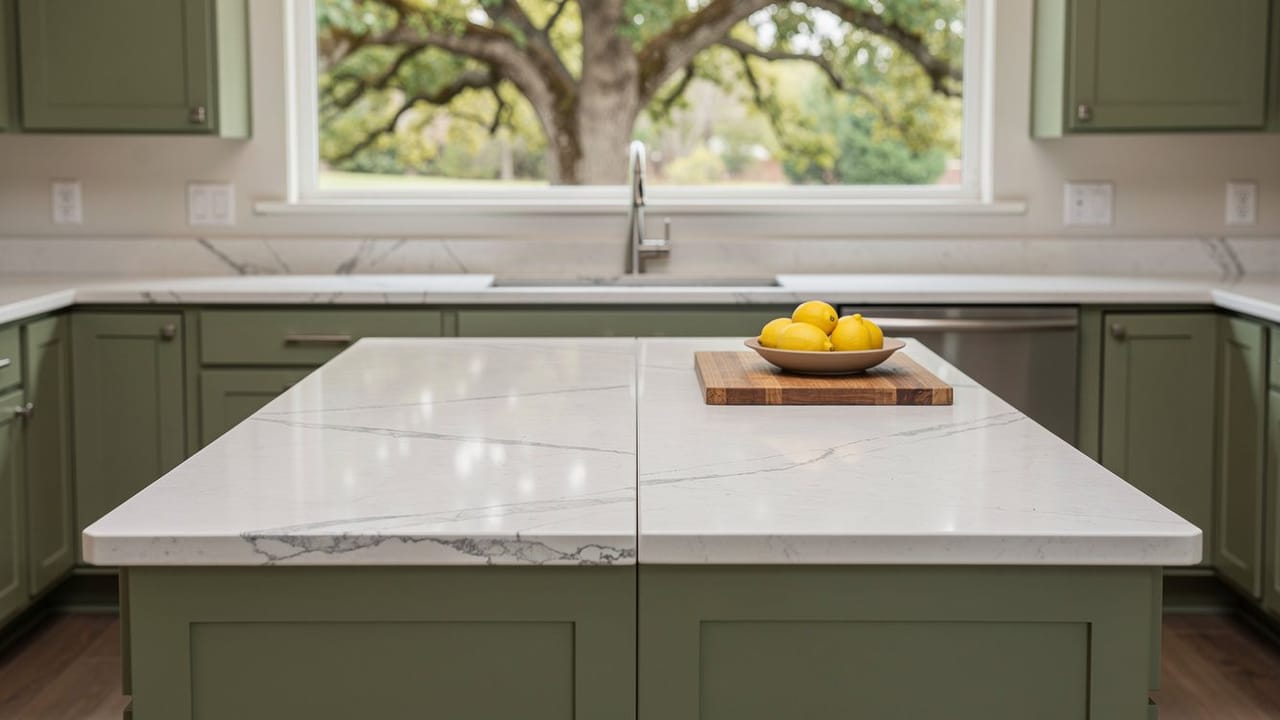
Stone slabs come in finite sizes, so any run longer than a slab has a seam. Where it falls changes how the top looks and how well the joint holds up, and the time to settle it is when we template and fabricate the top, not on installation day.
Why do countertops have seams?
Every slab has a fixed size. Cambria’s quartz FAQ lists its standard slab at 122 by 55.5 inches and its jumbo at 132 by 65.5, and asks buyers to confirm with their fabricator the largest piece that can actually be cut from one. An island longer than eleven feet cannot come out of even that jumbo slab, and neither can an L-shaped run that will not fit inside one slab’s rectangle.
Matching the two sides of a seam depends on the material. Manufactured quartz is blended and poured into a mold, while the Natural Stone Institute’s piece on quartz and natural stone makes the point that each piece of natural stone is unique, so a joint in granite or marble is matched by eye from what the slab gives you. Quartz is not perfectly uniform either: Cambria’s product care page describes variation in color, pattern and shade as inherent to its product.
Good and bad placement
We keep seams away from sink and cooktop cutouts wherever the layout allows. Once the opening is cut, the stone in front of it is a narrow strip, and a joint across that strip leaves very little material on either side. On a long straight run we would rather put the seam somewhere in the open middle.
Sometimes the layout leaves no other place for it, and then we say so before cutting. How the sink opening itself is cut and finished is on our edges, sinks and cutouts page. Seam fit also depends on what sits underneath, and Cambria’s care page warns that cabinets and walls that are not sound, straight, level and square can cause poor seam fit.
- Ask where the seams will be before fabrication
- Keep seams clear of sink and cooktop cutouts where possible
- Straight runs and inside corners are the first places we look
- Book-matching works on natural stone and on select veined quartz designs
- A visible seam is normal; a rough one is not
How invisible can a countertop seam be?
Expect to find a seam if you go looking for one. Cambria’s care page says its quartz is not a seamless product, that seams are visible, and that pattern and shade change where two pieces meet. The marks of good work are a tight joint, a level surface across it and filler colored to match the stone.
Anyone promising an invisible seam is overselling, in quartz or in patterned natural stone. Book-matching, where two pieces are cut so the veining mirrors across the joint, is one way to make a seam look intended, and it is not limited to natural stone: Cambria’s bookmatching page offers it in select quartz designs and says not every design suits it.
Overhangs and support
We do not quote one safe overhang figure for every top. The Natural Stone Institute’s comparison of natural and manufactured slabs treats flexural strength, a slab’s ability to resist bending without cracking, as a deciding measure wherever a top has cantilevered sections, and notes that thicker slabs resist bending better. The limit for a given material and thickness comes from its maker and the fabricator; past it, the overhang needs brackets or corbels.
This is decided before fabrication because it affects the cut. Our post on overhangs and support covers when a bar or island edge needs help, and a free estimate is a good time to ask where both the seams and the supports will go.
Sources
- Cambria, Quartz Countertops FAQs — Standard slab 122 x 55.5 in, jumbo 132 x 65.5 in; confirm the maximum piece size with the fabricator
- Natural Stone Institute, Is Quartz Natural Stone? — Manufactured quartz is blended and poured into a mold; each piece of natural stone is unique
- Cambria, Product Care — Not a seamless product, seams visible, pattern and shade change at seams; color and pattern variation inherent; unsound or out-of-level cabinets cause poor seam fit
- Cambria, Backlighting and Bookmatching — Bookmatching available in select quartz designs; not every design is suitable
- Natural Stone Institute, Comparative Performance of Natural Stone and Manufactured Slabs in Architectural Applications — Flexural strength governs cantilevered sections; thicker slabs resist bending better
FAQ
Where Countertop Seams Go and Why — questions
Can countertop seams be invisible?
No. Cambria says its quartz is not a seamless product and that pattern and shade change at a seam, and in patterned natural stone the veining cannot carry on exactly across the joint. What matters is that the seam is tight, level and well filled with a color-matched filler.
Where should a seam not go?
Across a sink or cooktop cutout, where the stone left in front of the opening is a narrow strip. We plan seams away from cutouts wherever the layout allows. If a layout forces one there, it should be explained and planned for before cutting rather than discovered on installation day.
How far can a countertop overhang without support?
There is no single number for every top. It depends on the material, its thickness and the limit the slab maker and the fabricator set, and thicker slabs resist bending better. Past that limit the overhang needs brackets or corbels, and the support has to be planned before fabrication.
How do you hide countertop seams?
You make them neat rather than invisible. A tight joint, a surface level across it and filler colored to match the stone are what good work looks like, and book-matching, cutting two pieces so the veining mirrors across the joint, makes a seam look intended. Cambria offers it on select quartz designs.