
· by Michael Blair, Nashville's Countertops
Every material looks good installed. The differences appear over years of a specific kind of use, which makes how you cook a better starting point than what you like the look of. Price is a separate question, and our countertops guide deals with it; this post is about the daily wear.
Which countertop handles hot pans best?
Granite usually does, because heat is where quartz gives ground. An engineered quartz slab is crushed quartz held together with polyester resin. The Natural Stone Institute, a stone trade group, puts it this way in its side-by-side of stone and engineered slabs: the resin in quartz may not take long, high heat, where dense stones such as granite and quartzite usually cope with heat and swings in temperature. A fabricator quoted in the institute’s article asking whether quartz is natural stone has replaced enough heat-damaged quartz tops to name electric skillets and slow cookers among the worst offenders, since both can crack or scorch the surface. If pans regularly come straight off the stove onto the counter, granite or a stone landing area beside the range is worth pricing.
Granite is not a license to skip the trivet. The experts in the institute’s granite care guide still tell owners to use cutting boards, trivets and cooling racks. On quartz the trivet is the whole answer. Cambria’s FAQ admits a pan set straight down may be more heat than its quartz can take, and its care page wants a hot pad with a tight weave, or something solid like a breadboard, under anything hot. A trivet in the drawer protects nothing, so keep one on the counter by the stove.
Is marble a good baking counter?
If marble is what you picture for a baking counter, know that it asks more tolerance of its owner than granite or quartz. It reacts to acid: a stone restorer the institute interviewed for its article on five stone-cleaning errors says marble, travertine and limestone react adversely with vinegar, and another warns that vinegar and bleach will etch the surface. The same article says an etched stone is fixed by honing and restoring it, not with a scrubbing pad. Putting marble on one baking section, with a more forgiving material on the rest of the run, keeps any etching to that one spot.
If you would rather have one surface everywhere, quartz is the one we would suggest. It is not immune to chemicals either: Cambria’s care instructions say to keep its quartz away from strong acids, strong alkaline products and abrasive cleaners.
- Hot pans off the stove: granite over quartz, with a trivet on both
- Baking: a marble section, or quartz throughout
- Low maintenance above all: quartz
- Chopping: a cutting board on every surface, stone or quartz
- Wood: an island top, for an owner happy to look after it
Low maintenance above all
Quartz, with two qualifications. Cambria’s product care page says its quartz is nonporous and nonabsorbent, resistant to stains, and never needs sealing, polishing or reconditioning, and it tells owners not to apply sealers or topical treatments of any kind because they wear off and dull the gloss. That is one manufacturer describing its own product, so read the care sheet for whichever brand you choose. The qualifications are heat, covered above, and the fact that Cambria itself says its quartz is not heat-proof, chemical-proof or fracture-proof.
Granite asks a little more. The institute’s granite care experts recommend sealing most granites, on a timeline that depends on how the counter is used and which sealer went on. Their home test is to leave some hot water on the stone for 10 to 20 minutes and wipe it off; if the spot darkens, the stone is still taking on moisture. Our post on sealing and maintaining stone covers that routine. For a household that wants to think about the counter as little as possible, that extra step is why we usually suggest quartz. The edge you pick has a say in upkeep too, and our post on choosing a countertop edge profile compares how each shape cleans.
Mixing materials
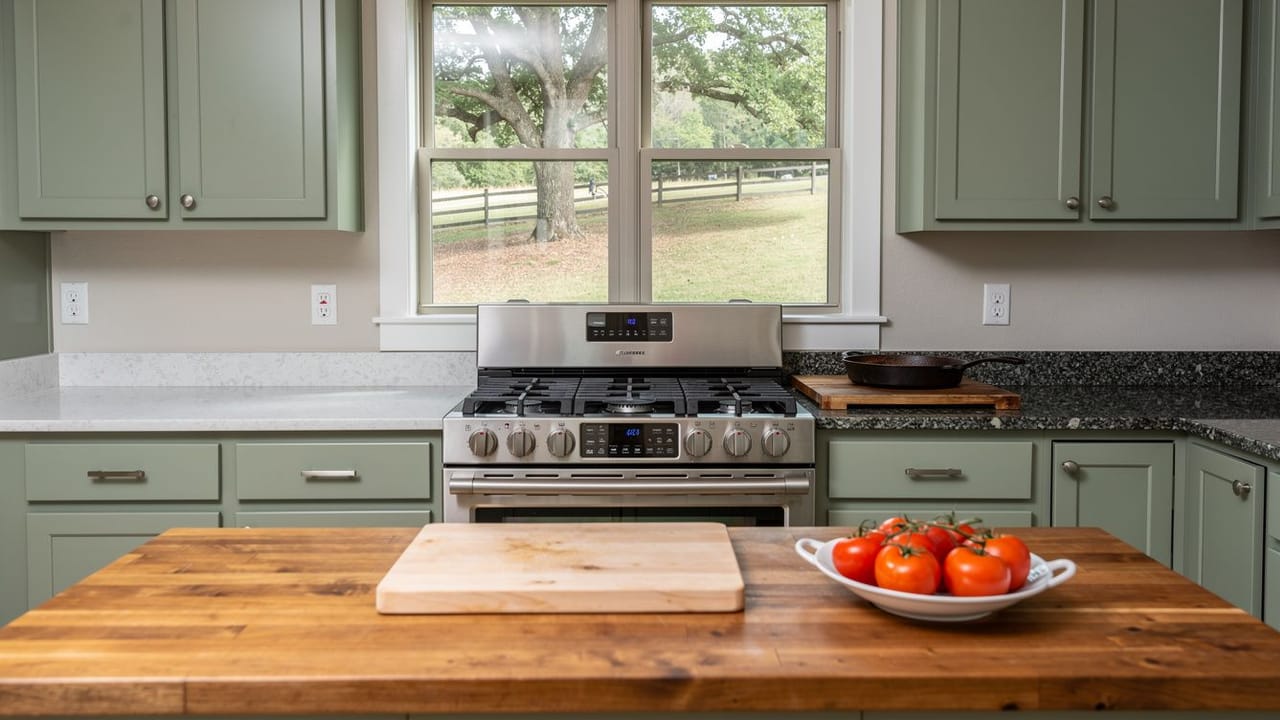
Using different materials in different zones is entirely practical: quartz on the main run, wood on an island, marble on a baking section. Wood is the one that needs the most owner involvement, and we wrote up what a butcher block top is like to live with for anyone weighing it for an island.
Two materials mean two orders, two sets of cuts and two care routines to learn, which is why our quotes break a mixed kitchen down zone by zone. When you have a sense of how your kitchen gets used, send us the layout for a free estimate.
Sources
- Natural Stone Institute (Use Natural Stone), Comparative Performance of Natural Stone and Manufactured Slabs in Architectural Applications — Quartz resins may be sensitive to sustained high temperatures; granite and quartzite generally tolerate heat; some surfaces resist stains but etch with acids; no single metric decides suitability. Trade association, 2026.
- Natural Stone Institute (Use Natural Stone), Is Quartz Natural Stone? — Quartz slabs are quartz bound with polyester resin; a fabricator names electric frying pans and slow cookers as causes of cracked or scorched quartz. 2019.
- Natural Stone Institute (Use Natural Stone), Caring for Granite — Sealing recommended for most granites; the hot-water test for 10 to 20 minutes; use cutting boards, trivets and cooling racks. 2018.
- Natural Stone Institute (Use Natural Stone), 5 Common Mistakes to Avoid When Cleaning Natural Stone Surfaces — Marble, travertine and limestone react to vinegar; vinegar and bleach etch; etched stone is honed and restored; etches can become part of the stone’s story. 2017.
- Cambria, Quartz Product Care — Nonporous and stain resistant, no sealing; no sealers or topical treatments; hot pad or solid trivet under pans; not heat-proof, chemical-proof or fracture-proof; avoid strong acids, alkalis and abrasives. Manufacturer, own product.
- Cambria, Quartz Countertops FAQs — Cambria may not withstand direct heat from pots and pans; nonabsorbent, no regular sealing, stain resistant. Manufacturer, own product.
FAQ
Matching Worktop Material to How You Cook — questions
What is the most durable countertop material?
There is no single answer, because each material fails in a different way. Cambria says its quartz is nonporous, stain resistant and needs no sealing, but resin-bound quartz can scorch or crack under sustained heat. Granite generally handles heat better, and most granite is sealed. The Natural Stone Institute’s own comparison says no single measure decides which slab suits a use, so start from the failure that would bother you most in your kitchen.
Is marble a mistake in a working kitchen?
Not a mistake, but a choice with known consequences. Marble reacts to acids such as vinegar, and an etched surface has to be honed and restored to fix it. The Natural Stone Institute notes that many owners come to see small etches and imperfections as part of the stone’s story. If that would frustrate you, a marble baking section with quartz elsewhere keeps the marble where you want it.
Can I mix countertop materials in one kitchen?
Yes. Quartz on the working runs, wood on an island and marble on a baking section is a practical layout. Each material comes from its own slab or board and has its own care routine, so ask for every zone priced separately on the quote. Just keep the palette deliberate rather than accidental.
What is the easiest countertop to maintain?
Quartz, for most households. Cambria says its quartz is nonporous, resists stains and never needs sealing, polishing or reconditioning, though it is not heat-proof and wants a trivet under hot pans. Granite asks a little more, since most granites are sealed on a schedule that depends on use and the sealer.