
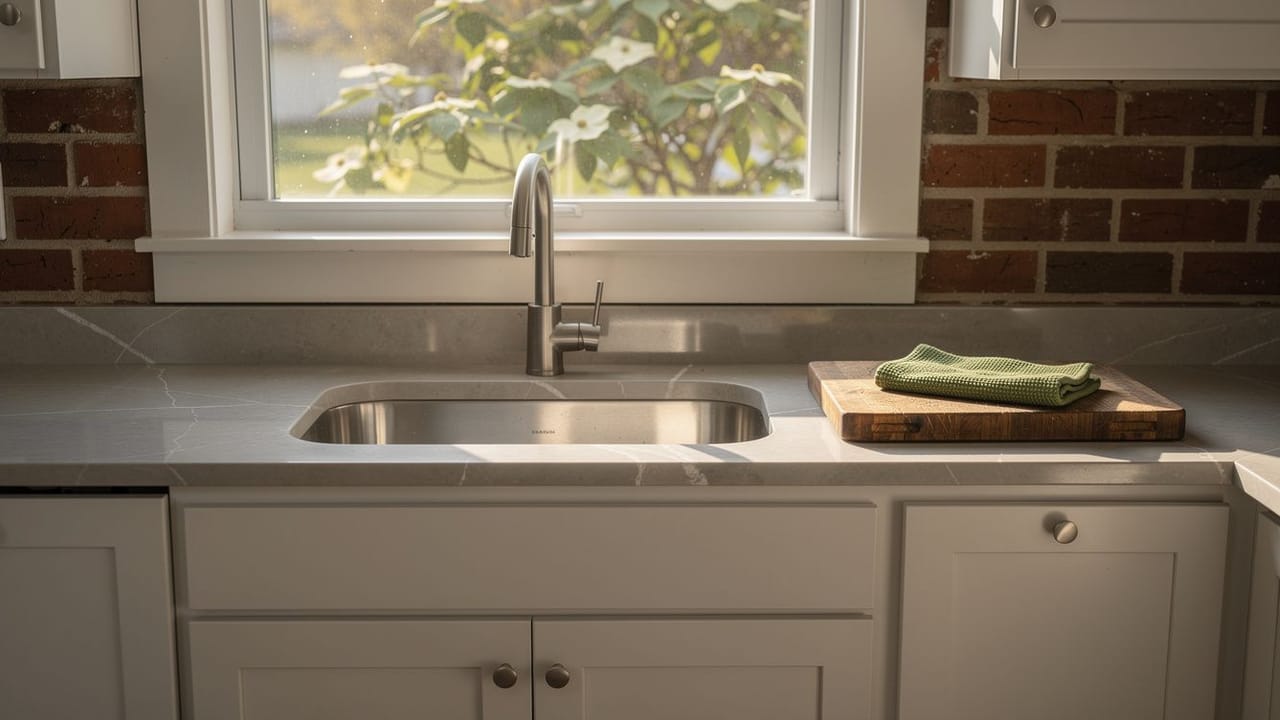
· by Michael Blair, Nashville's Countertops
The sink has to be chosen before the countertop is templated, because the countertop is cut for it; Cambria’s quartz FAQ lists your sink and stove locations and dimensions among the things a fabricator needs just to give an accurate estimate. The two mounting styles ask different things of the material. A drop-in sink sits on top of the counter with a rim that covers the cutout, and an undermount hangs beneath the counter with the cutout edge finished and exposed. That difference decides which materials can take each, how the sink is held up, where the joint sits, and how the counter gets cleaned for as long as you own it.
Which countertops can take an undermount sink?
An undermount needs a countertop whose cut edge can be polished and left on show, wet, every day. Quartz is one: Cambria’s FAQ says its surfaces can be used with any undermount or drop-in sink, stainless steel, cast iron, porcelain, solid surface and composite included. We polish undermount cutouts in granite and quartz in the shop, as part of the sink and cutout work on every top we fabricate. For a laminate counter we fit a drop-in instead, so the rim covers the cut edge and keeps water off it. A wood counter is its own question, and our post on living with a wood countertop goes into what it asks of you.
A drop-in asks much less of the counter, since the cut edge is hidden under the rim and never has to be finished. That makes it the practical answer for laminate and tile, and for a sink being replaced in a counter that is staying, where the old cutout gets reused.
How each is installed
When we set a drop-in, it goes into the opening on a bead of sealant and its rim rests on the counter. Swap it later for a sink that fits the same opening and the counter itself never needs touching.
An undermount hangs from the underside of the counter. We mount it with the hardware and method its maker’s installation instructions call for, and we seal the joint between sink and stone with silicone. For a cast-iron or fireclay sink, we add support under the bowl rather than leave it hanging on clips alone, and whoever installs yours, it is fair to ask what will be holding it up. The cutout edge is polished, and before we cut we agree with you where it sits against the sink wall: flush with it, slightly over the bowl as a positive reveal, or set back so a narrow strip of the sink’s rim shows as a negative reveal. That is settled at the template, which our page on templating and fabrication walks through.
- Drop-in: the rim covers the cut edge and rests on the counter; suits laminate and tile
- Undermount: polished cutout in stone or quartz, with support underneath for a heavy sink
- Reveal: flush, positive or negative, agreed before the cut
- Faucet holes: drilled in the stone for an undermount; for a drop-in, check whether the sink deck already has them
Where each one fails
The drop-in’s weak point is the rim. Crumbs gather along it, you can’t sweep the counter straight into the bowl, and the sealant under it is all that keeps water off the cut edge. A bead that has darkened, cracked or lifted is worth redoing before water works its way underneath.
With an undermount, the weak points are out of sight: the silicone joint and whatever holds the sink up. If the bead opens, have it recaulked so water doesn’t sit in the gap. When we’re called to an undermount that has sagged away from the stone, we look at the supports before we touch the silicone.
The polished edge around the cutout takes knocks as well. Cambria’s product care page says objects hitting edges, particularly at sinks or dishwashers, may cause chips, and that no stone is chip-proof. Marble carries a second risk: the Natural Stone Institute’s article on stone-cleaning mistakes warns that marble, travertine and limestone react to acidic vinegar, which etches the surface, and that an etched stone can only be fixed by honing and restoring it. Granite shows its age at the sink first, too; a restoration contractor quoted in the Institute’s guide to caring for granite says most of the granite restoration calls the firm receives are for countertops 10 to 15 years old that have gone dull around the sink and work areas. If a chip does happen, our post on repairing a chipped or cracked stone worktop covers what can be fixed in place.
Which sink suits a new stone or quartz counter?
On a new stone or quartz counter we usually recommend an undermount. Crumbs and water wipe straight into the bowl, the line around the sink is clean, and the joint sits below the surface where nothing lands on it. Ask how the sink will be supported, pick a small negative reveal if you would rather have no stone lip over the bowl, and keep an eye on the silicone so it gets redone when it opens.
We point people to a drop-in when the counter is laminate or tile, when an existing cutout is being reused, or when a heavy sink is going into a cabinet with no room to support it from below. A farmhouse sink is a third route, and Cambria’s FAQ lists farmhouse styles among the sinks its quartz works with; tell us before the template if that is your plan. A good drop-in with a low-profile rim and a careful sealant bead is the right sink in those kitchens, and when you want to talk through yours, ask us for a free estimate.
Sources
- Cambria, Quartz Countertops FAQs — Sink and stove locations and dimensions needed for an accurate estimate; quartz can be used with any undermount or drop-in sink, including cast iron, and with farmhouse-style sinks
- Cambria, Product Care — Objects hitting edges, particularly at sinks or dishwashers, may cause chips; no stone is chip-proof
- Natural Stone Institute (UseNaturalStone.org), 5 Common Mistakes to Avoid When Cleaning Natural Stone Surfaces (2017) — Marble, travertine and limestone react to acidic vinegar, which etches the surface; etched stone is fixed only by honing and restoring
- Natural Stone Institute (UseNaturalStone.org), How to Care for Your Granite Countertops (2018) — Restoration contractor: most granite calls are for countertops 10 to 15 years old gone dull around sink and work areas
FAQ
Undermount or Drop-In Sink With a New Countertop — questions
Can an undermount sink be installed in laminate countertops?
We don’t install them that way. An undermount leaves the cut edge of the counter exposed and wet, and a laminate top’s cut edge is not finished for that, so for laminate we recommend a drop-in, whose rim covers the cutout and keeps water off it.
How is an undermount sink held up?
From the underside of the counter, with the mounting hardware and method the sink maker’s installation instructions call for, and a bead of silicone seals the joint. For a cast-iron or fireclay sink we add support under the bowl rather than leave it on clips alone. Ask whoever installs yours what will be holding it up.
What is a negative reveal on an undermount sink?
It is the term for a cutout made slightly larger than the sink opening, so a narrow strip of the sink rim shows around the inside. There is no stone lip over the bowl, which some people find easier to wipe. A positive reveal has the stone overhang the bowl slightly, and flush lines the two up exactly. We settle which one you want before the template.
How do I know if my sink is undermount or drop-in?
Look at the edge of the bowl. A drop-in has a rim that rests on top of the counter and covers the cut edge, so you see the sink’s lip sitting on the surface. An undermount hangs beneath the counter, and you see the finished cut edge of the stone around the opening instead.